
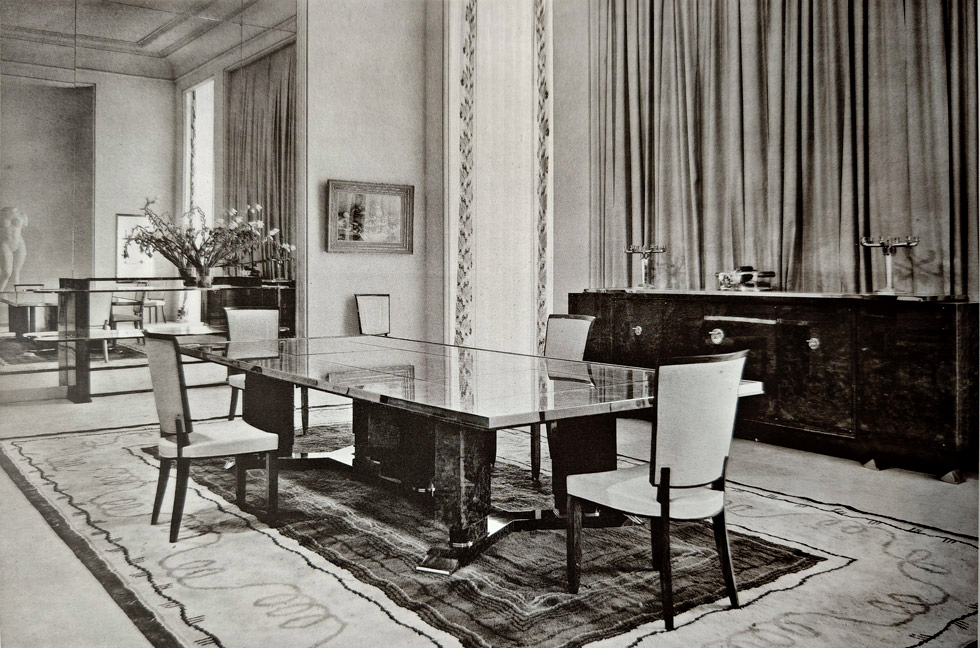
The Exposition Internationale des Arts Décoratifs et Industriels Modernes, held in Paris in 1925, marked the official birth of Art Deco, an artistic and decorative movement that had been developing since the 1910s and would eventually become a global benchmark for modern design.
The birth of Art Deco in Paris
Exactly 100 years ago, Art Deco began its international expansion. In the midst of the transition from the Belle Époque, dominated by the organic forms of Art Nouveau, this new style emerged as a clear reaction against the so-called ‘Nouille’ style, favouring geometry, order and rationality.
In its early years, the Art Deco movement proposed a return to classical rigour inspired by the Viennese Secession: symmetry, proportion and classical orders reinterpreted in a stylised form. This approach gave way to an aesthetic based on clean lines, dominant geometry and a new way of understanding architecture and interior design.
The 1925 Paris Exhibition and its international impact
The 1925 international exhibition marked a definitive turning point in the history of Art Deco. After the interruption caused by the First World War, this event marked the beginning of its international projection and its consolidation as a symbol of modernity.
Unlike other movements, Art Deco was not limited to architecture. Its influence extended to furniture, fashion, posters, advertising, automobiles, textiles, wallpaper and tableware. Whether in a monumental building or an everyday object, Art Deco conveyed elegance, progress and sophistication.
The popularisation of transatlantic travel contributed to the rapid spread of Art Deco. Born in Paris, the style spread throughout Europe, America, Africa and Asia, establishing itself as a global visual language.
Influences and visual language of Art Deco design
Art Deco design was characterised by glamorous escapism and an exuberant, unapologetic aesthetic. Its geometric lines and symmetries were complemented by influences from ancient cultures such as Egyptian and pre-Columbian civilisations, as well as Oriental and African elements.
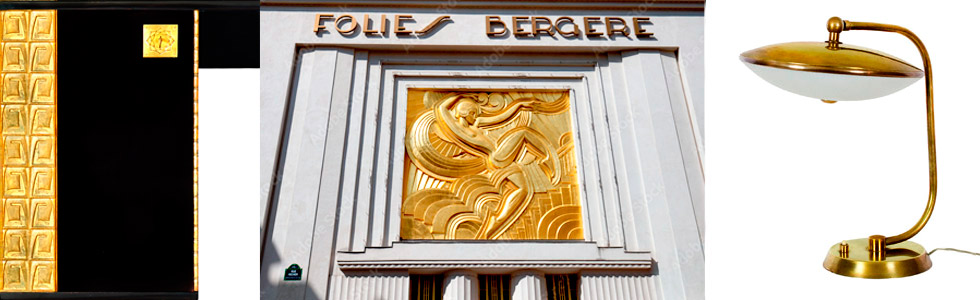
This visual language reflected the spirit of an era that trusted in machinery, technological advancement and order as the drivers of progress.
Art Deco and interior design
The 1925 Exhibition marked the triumph of Art Deco interior design in France and consolidated the figure of the professional decorator. Names such as Jacques-Émile Ruhlmann, Jules Leleu, André Groult, Jean-Michel Frank and Pierre Chareau, among many others, defined a way of inhabiting spaces based on elegance and refinement. They introduced a mixture of luxurious and modern materials, highlighting exotic woods (Macassar ebony, rosewood), shiny metals (chrome, steel, brass, bronze), glass (frosted, opalescent), marble, lacquer, and synthetic materials such as Bakelite, along with animal skins to create a style that reflected modernity and opulence.
The legacy of Art Deco today
A century later, Art Deco is still present in building facades, architectural elements such as railings and doorways, signs with gold lettering, and French Art Deco furniture of great historical value.
Thanks to its presence in all disciplines of design, Art Deco can be found both in urban spaces and in museums specialising in furniture, lighting and decorative objects. Its permanence, sometimes almost imperceptible, is an essential part of its charm.